
Growing up, I didn’t think too hard about why my nani took us to Gurudwaras.
I just covered my head when told, sat through the prayers, waited for langar, and accepted that adults had their own mysterious spiritual logistics. But somewhere between hearing verses from the Guru Granth Sahib, watching my nani pray to Guru Nanak Ji with complete familiarity, and eating the best kada prasad known to humanity, one thing quietly stayed with me.
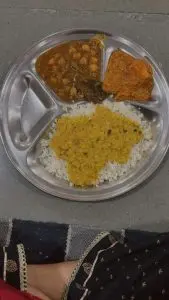
Langar wali thali
Gurudwaras are so commonly associated with Sikhs, Sardars and Punjabis that I didn’t realise, for years, that our Sindhi comfort there had a whole history of its own.
Mostly because nobody sat me down with a whiteboard and said, “Beta, today we will discuss the historical relationship between Sindhis, Sikhism, Nanakpanthi traditions, Partition, and inherited spirituality.”
Rude, honestly.
Instead, like most things in South Asian families, the answer came through habit first. Through summer vacations and my nani’s routine. Through old photographs of Guru Nanak Sahib on the wall and prayers I heard before I understood them.
Through spaces that felt like home long before I knew their history.
Well, this one is not your same old ‘suddenly discovering a new faith’ story.
It is about realising that something I thought belonged to someone else had been part of my own inheritance all along.
Before History, There Was Nani
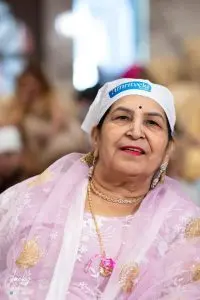
The writer’s nani
My nani was the kind of woman who dedicated her life to her guru, her children, and then her grandkids, which is basically the holy trinity of nanihood.
My nanu called her Kiki. She was loving, warm, deeply devoted, and had that specific Sindhi-Punjabi-Sikhni aunty energy that cannot be manufactured. You either have it, or you don’t.
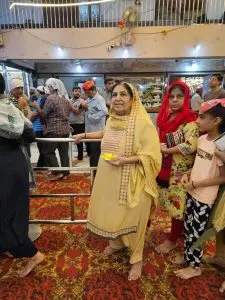
The writer’s nani at the Gurudwara
She gave me my love for parandas and patiala saawars. She dressed me in clothes she made herself. Nani fed me, played with me, spoiled me in the legally approved nani way, and somehow made faith feel less like a rulebook and more like a rhythm of the house.
During summer vacations, all the cousins would gather at her home. Mornings had their own chaos. Everyone had to brush. Everyone had to bathe. Everyone had to stand in line like we were auditioning for a family version of military school. Then we’d open our suitcases, pick our favourite clothes, and get ready like our lives depended on it.
Because in a way, they did.
If we were late, nani would leave without us. Or worse, she would take only the cousins who were ready.
At Nani’s house, spirituality came with its own consequences.
The Gurudwara Felt Like Nani’s World
The Gurudwara she took us to was old-fashioned. It was quiet in that way; some places are silent even when people are moving around. An elderly Sardar uncle would read from the Guru Granth Sahib. We would cover our heads, take a rumala sahib from the pile outside, enter, sit down, and watch.
The idea is simple: you enter with respect.
As a child, I didn’t know all this language. I just knew the steps.
Cover your head. Sit quietly. Don’t fidget too much. Try not to fall asleep.
My nani would read Japji Sahib, the morning prayer composed by Guru Nanak Ji. The prayers would end with ardas, the collective prayer of supplication and gratitude. And somewhere in the middle of all this, I would become completely hypnotised by the chaur sahib, the ceremonial whisk waved over the Guru Granth Sahib as a sign of reverence.
The slow movement of it was so calming that it almost put me to sleep.
Honestly, if meditation apps had chaur sahib visuals, half of us would be healed.
Then came the part every child understood without needing theology: kada prasad.
Warm. Ghee-loaded. Soft. Sweet. Absolutely undefeated.
The old sardar uncle, whom we called Babaji, would give it to us while chanting, “Waheguru, Waheguru.” I didn’t know the full history of what I was part of. But I knew that prasad felt like love being placed into my hands.
We’d come home, eat breakfast, and continue with our day. That was the routine. That was nani’s world.
And because it was nani’s world, I accepted it.
Here’s Where the Confusion Entered
Back at my paternal home, the spiritual setup looked different. There was not the same everyday Gurudwara rhythm. We did have a Sindhi Tikana, a devotional space where we prayed to a different guru, and only much later did I realise that in one section, the Guru Granth Sahib was kept there too.
As a child, I didn’t know this.
So in my head, nani’s Gurudwara world felt separate. Almost like something from her side of the family, her city and her rhythm. My paternal side felt more like a Sindhi Tikana setup, a mixed devotional space with Sindhi, Hindu, and Sikh influences sitting together in a way nobody seemed to find confusing except, eventually, me.
Because outside the home, the categories felt clearer.
Sindhi. Sikh. Punjabi. Hindu. Gurudwara. Mandir.
Clean labels. Separate folders.
But inside our families, faith did not behave like a school notebook. It moved through rooms, rituals, photos, prayers, idols, scriptures, food, songs, and grandmothers who did not pause to explain the academic framework before taking you along.
And honestly, maybe that is why it took me so long to understand it.
I Was Trying To Put Nani’s Faith Into Boxes She Had Never Used
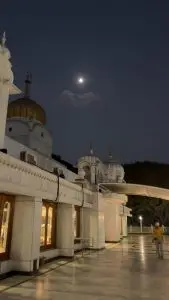
The facade of the Gurudwara
The more I read, the more my childhood memories rearranged themselves.
In many Sindhi devotional spaces, especially tikanas, the Guru Granth Sahib has historically been kept with deep reverence, sometimes alongside Hindu deities and other devotional symbols. That may sound confusing if you are used to clean set of religious boundaries, but Sindhi spirituality has often been more layered than what most people perceive. It has carried influences of Hinduism, Sikh teachings, Sufi traditions, local saints, Jhulelal devotion, family gurus, and community practices, sometimes all in the same emotional room.
This does not mean Sindhis and Sikhs are the same community.
It does not mean every Sindhi family follows the same practices.
It definitely does not mean we can flatten everyone’s faith into one cute ‘unity in diversity’ poster and call it a day.
It means the lived history is more complicated, and honestly, more interesting.
For many Sindhi families, Guru Nanak Ji was not someone else’s Guru. He was part of the spiritual vocabulary of the home. Present in prayers and photographs. Present at Gurpurab celebrations. Present in the Guru Granth Sahib kept in tikanas. Present in the way elders spoke of faith, even when they did not explain it like a podcast episode.
Which, frankly, would have helped.
But no. We got mystery, prasad and vibes.
And Then There Is Partition
Because no story about Sindhi identity can really avoid it. Partition did not just move people from one side of a border to another.
It moved languages, recipes, gods, prayers, scriptures, grief, habits, and the tiny rituals families kept repeating because stopping would feel like losing one more thing.
After Partition, many displaced Sindhi families rebuilt their lives across India, in places like Rajasthan, Gujarat, Maharashtra, Madhya Pradesh, Delhi, and beyond. KBS Sidhu’s essay notes that Sindhi Hindus carried saroops of the Guru Granth Sahib with them and rebuilt tikanas where Gurbani remained central to community gatherings.
That detail stayed with me.
It’s one thing to say a community values a tradition. It’s another to carry it with you when everything else around you changes.
Sindhi families rebuilt their lives from scratch after Partition. New cities. New homes. New beginnings. But many of them still made space for Gurbani, paath, Gurudwaras, and the practices they had grown up with.
There is something quietly moving about that.
At Some Point In School, This World Appeared Again
I did a project on the ten Sikh Gurus, from Guru Nanak Sahib to Guru Gobind Singh Ji, who declared the Guru Granth Sahib as the eternal living Guru of the Sikhs. I remember writing it down, learning the order, understanding the broad story, and feeling like I had touched a part of history that was both familiar and not fully mine yet.
Then life did what life does.
Boards happened. Exams happened. We grew older. Nani shifted homes. Summer vacations became shorter. We stopped going to her house for long stretches. The Gurudwara visits slowly faded into memory.
Not dramatically.
Just quietly.
But they didn’t fade from hers.
When she celebrated big wins like moving homes, she kept Paath Sahib at home, bringing the sound of Gurbani into her own space, almost as if the Gurudwara had travelled with her. For my nani, it is a love language. She didn’t just visit Waheguru Ji. She made room for that presence wherever she lived.
My childhood rituals, though, disappeared. One year, you are doing them. Then one year you are not. And nobody announced the last time.
Pune Brought It Back
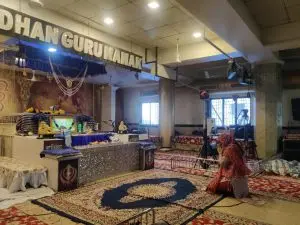
A Gurudwara in Pune
Years later, in Pune, the thread found me again.
In my first year, on Guru Nanak Jayanti, my Punjabi roommate and I decided to visit a Gurudwara. I didn’t know then that this would become one of my most peaceful places in the city.
But it did.
I started going often. On Guru Nanak Jayanti. On New Year’s. At the beginning of something. At the end of something. When I wanted to say thank you. When I wanted to pray.
When my mind needed a place to sit down and stop behaving like a browser with 47 tabs open.
And slowly, I began taking people with me.
Punjabi friends. Muslim friends. Spanish friends. Marathi friends. My Marwari best friend. Office friends. People I loved. People I wanted to know better.
Yes, even dates.
Listen. Some people do coffee. Some people do cocktails. Apparently, I do spiritual soft launches.
But it made sense to me. A Gurudwara is one of the few places where I have always felt that nobody is asking you to perform belonging. You cover your head, sit down, listen, eat prasad, maybe help, or just be. It is calm without being cold. Open without being loud. Sacred without making you feel like you need a membership card.
For me, taking someone there became a way of saying, “This is where I come from.” This is what calms me. This is a part of me I want you to see.
The Place Was Never Just a Place
The more I returned to Gurudwaras as an adult, the more I understood what nani had given me.
She had not given me a lecture. She had not explained history, syncretic Sindhi spirituality, the role of Guru Granth Sahib in tikanas, or the spiritual overlap between Sindhi and Sikh communities.
She had simply taken me with her.
And maybe that is how grandparents pass things down. Not always through explanation. Sometimes through repetition. Through where they take you. Through what they bow before. Through what they make feel normal.
As children, we think we are just being dragged along.
As adults, we realise we were being introduced.
The Part That Still Hurts a Little
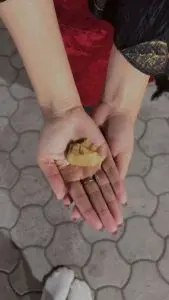
Kada prasad
I had always wanted to take nani to the Gurudwara I loved in Pune.
I had told her about it so many times. I imagined sitting there with her, showing her the space that had become mine in a city far away from home. I imagined her looking around, approving it in her quiet nani way, maybe telling me something I would pretend to understand fully and then decode five years later.
But before I could take her, she passed away.
So now, whenever I go, I carry her with me.
Every beginning. Every thank you. Every quiet prayer. Every Guru Nanak Jayanti. Every time I sit there, and the world finally lowers its volume, I think of those summer mornings. The cousins rushing to get ready. The old Gurudwara. Babaji saying “Waheguru.” The kada prasad in my hands.
My nani sitting there with a faith that did not need to justify itself to anyone.
Maybe This Was Always Mine
For a long time, I thought my confusion came from not knowing enough.
Now I think it came from being taught to see faith as something with hard borders.
But my nani’s faith did not move like that. Sindhi history often did not move like that either. It moved through migration, memory, devotion, adaptation, loss, rebuilding, and the stubborn tenderness of families who carried what mattered even when they had to leave almost everything else behind.
So when people ask why Sindhis go to Gurudwaras, why many revere Guru Nanak Ji, why the Guru Granth Sahib appears in some Sindhi spaces and why this connection exists at all, the answer is not a simple, one line.
It is history.
It is Nanakpanthi tradition. It is Sindh’s layered spiritual landscape.
It is Partition. It is my grandparents. It is the way faith sometimes arrives before language. It is the way a child can sit in a Gurudwara, not fully understanding anything and still feel held.
Maybe my nani did not introduce me to a new faith. Maybe she helped me recognise one that had been waiting inside my own history.
And maybe that is why, even now, years later, whenever I enter a Gurudwara, I don’t feel like I am stepping into someone else’s space. I feel like I am returning to something she knew before I did.
To the sound of “Waheguru” under someone’s breath. To kada prasad warm in my hands. To a faith that arrived first as routine, then as memory, and finally as belonging.
Jo Bole So Nihal, Sat Sri Akal